Showing posts with label Philosophy. Show all posts

Sunday, March 9, 2014

Trees vs Choices

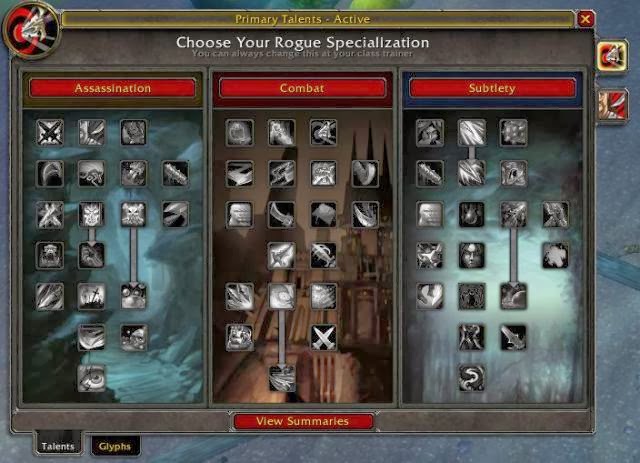
After spending some time with Diablo III, I was reminded of maybe the most fundamental change between D2 and D3, and in "old" Bizzard and "new" Blizzard.  Most of you are probably aware of the skill trees in Diablo 2.  Some of you may have played World of Warcraft.  Both had skill trees that looked like a flow chart:
A Diablo II skill tree.
An "old" WoW talent tree.
Both operated on the idea that at various experience levels you gained points to spend in the trees.  These points either improved abilities or unlocked new ones.  Diablo 3 and the new WoW talent trees both dumped that approach in favor of unlocking core abilities at certain levels, and then providing a small number of choices.  In D3 this takes the form of glyphs that alter a given ability.  In WoW, the system is a little more convoluted, but at each talent tree level you generally get to choose between three additional abilities or modifications.
Picking glyphs for a skill in Diablo 3.

The "new" talent tree in WoW.
 Another major change in the system was that in the old point-based system respeccing your skills was either impossible or incurred a fair amount of expense.  D3 did away with this, allowing you to swap skills and glyphs any time you are not in combat.  WoW has slowly made it easier and easier to change you spec, in both the old and new systems.

I think this system works well in Diablo, but feels a bit hollow.  This system was one of the key factors that led me to stop playing WoW altogether.  The reason is that in both games, a lot of the urge to play is based on investment in your character.  Most RPGs and MMOs work this way.  Conversely, shooters have little need for this.  In a game where you respawn frequently and death is a common feature, investment comes from how enjoyable the mechanics of the game are.

This change in how players customize their characters leads to a hollow experience, at least for me.  Instead of thinking and tweaking and theorycrafting my characters, I get a few choices which can be quickly swapped out until I find the most effective method for dealing the most damage.  Instead of taking pride in being a Marksmanship or Beast Mastery Hunter, I was left with a few clicks to make and alter.  My investment in balancing my skills and developing a strategies based around my strengths and weaknesses went away.

An example of this change:  In Burning Crusade era WoW, I gained a small amount of notoriety on my server as a hunter who could solo just about anything, an occasionally people would come watch me try out some new strategy to deal with boss level creatures outside Illidan's Temple or tag along to watch me take out Gruul by myself.  It was fun, it fostered community, and it really gave me a reason to inhabit the shoes of Grimmash, Orc Hunter.  You could even figure out a lot about a character based on the armor set they chose.  Seeing a player wearing a particular set of armor told you a lot about how they fought, what talents they likely had, and maybe even about their personality, as certain play styles often drew particular types of people.

Now, with such customization gone, I have lost most of the investment in Grimmash, Orc Hunter.  All that maters is speccing the right way for the fight at hand, and hot-swapping out skills based on the dungeon.  This is even more pronounced in Diablo 3, where I have never even considered what the personality of Kul Turas the barbarian.  In Diablo 2, you had no choice to change skills once assigned, so your build was often very idiosyncratic and personal.  Each character was a significant investment.

From a gaming philosophy standpoint, this poses a question.  To set that question up, it is often assumed that developers must make a choice between complex skill systems that satisfy hardcore players, or simple skill systems that foster a broader casual appeal.  The question becomes:  Is this supposed balance real, or a figment of developers' imagination?  Is the sales and marketing department forcing a false dichotomy on developers?

I hope the answer is that this is a false dichotomy, but as many marquee games seem to only be willing to try the simple approach, we may be passing into an era of gaming where it will be harder to find rewarding skill systems in the name of casual sales.  

Thursday, March 7, 2013

Objects in Space

Note: This is old material, sitting in my draft bin for a long period of time.  The links are also to the old articles that got me thinking.


Why should ships log off when players log off?  This has always interested me in Eve.  My understanding of the current mechanic is that, aside from timers, if you log off while in space, you go into a "warp stasis", where your ship is apparently in a pocket dimension that you mysteriously come back from when you log back in.  From a technical standpoint, I can sort of understand this.  There are already enough objects in space on the server.  But perhaps if you log off while in space, your ship should stay where you left it?

This would fit with the ideas behind stations and POSes.  Stations are where you go to get out of your ship, get other ships, trade, and so on.  Stattions are also the only almost completely safe space in Eve.  No one can blow up your ship while it's docked.  In space where stations do not exist, POSes fulfill this role with hangars and force fields.  Would anyone leave a valuable ship sitting in a WH outside the POS shields?

From a PvP perspective, this would make all sorts of logging strategies effectively worthless, unless you felt safe leaving a ship at deep safes and assuming no one would come find you.  It would eliminate the idea of invisible campers in WH space, assuming the residents actually took the time to use combat probes.  It would also require gate campers to actually show their presence in space instead of hiding in the warp stasis bubble.

As for what happens to a logged out ship floating in space, there are options.  I imagine the status of the ship would be to continue running whatever modules were active when you logged.  So many ships would eventually cap out, then drift once recharged.  The biggest problem I see is the problem of what happens to your velocity.  It would cause problems to have ships just... fly forever.  So maybe you program autopilot AI that says if a plaer is logged out for X minutes, the ship finds the nearest celestial and warps to it.  You could even give people the option of what celestial, or station, and what distance to choose, and if docking is completed.  You'd probably need a default of 1000km from the nearest planet if none of the player options are available to deal with station docking rights and WHs, but there could be a system.

All of this is to say that the whole log off in space mechanic in Eve seems to be a throwback to computing limitations.  In many ways, the log of mechanics still provide some rather big bugbears.  Gate camps and WH squatters come to mind.  Would it hurt to have objects in space become a little more persistent?

Thursday, April 12, 2012

Growing Up


Now approaching its tenth year, the EVE Online player community has matured into an intricate and multi-faceted society viewed with envy by other game developers, but is frequently regarded with suspicion by the wider gaming community. 
Is this perception deserved? Should "The Nation of EVE" be concerned by its public identity and if so how might that be improved? What influence will the integration of the DUST 514 community have on this culture in the future?

Any discussion of the Eve community is tricky.  When you think of Eve from the inside, there are myriad groups all work with and against each other.  How do you succinctly capture a community that includes the CFC, R & K, Rote Kapelle, Tuskers, Faction Warfare, RP junkies, pirates, miners, inventors, manufacturers, wormholers, carebears, and traders?  Then add the flavors of each in all the various parts of space.  Then look at the meta community, which adds yet another layer. 

I suppose the common theme to all the players who keep coming back is one of involvement.  The only way to succeed in Eve is not play, but if you ignore that, you reach a semblance of success by being involved.  Involved with other players, with the markets, with whatever your chosen niche of the game is.  On to the questions: Is the perception of Eve as a suspect community deserved?  Should the Eve community care about this? Will Dust 514 impact either of these things?

"You will never find a more wretched hive of scum and villainy.  We must be careful."
-Obi-wan Kenobi

The gaming media loves Eve.  It seems the pace of scandals, scams and general player outrage have picked up pace over the last year.  Some of these things were intended by CCP, some… not so much.  But Eve is the juicy steak at the MMO table, the friend who you don’t remember inviting to the party, but always shows up and everyone remembers that one thing he did.  There are two sides to this reputation. 

Almost every person I have talked to who is a gamer says “Hey, I heard about that crazy Guiding Hand thing…” or “Wasn’t there some ship blown up that was worth a lot of money and people made fun of the guy for being stupid?”  If the conversation continues, my companion usually eithers says something along the lines of “That’s awesome!” or “I would never play a game that risky!”.  This is a good thing.  Eve requires a level of devotion not seen in other games, and the people who say “Awesome” are the players we, and CCP, want playing our game.  They add to it, and help create the story that is New Eden.

The other side of the coin is “cyber-bullying”, photo-shopped Tyrano-Dictators, racism, sexism, terms like “spacejews”, and the unsavory RMT/Botting/Espionage events that happen in the client and the meta-game.  Some of those things are good.  Espionage, for example, is a great aspect of the game.  Some of these things, like racism and sexism, are not Eve-centric, but rather afflict gaming as a whole.   I’ve written about some of these habits before. 

The gaming media is more than happy to jump on these events, and often “Our Eve” and what the rest of the world sees as “Eve” can be very different.  Accurately portrayed or not, the gaming media is where a lot of players get information, and informs where players put their paychecks.  Eve thrives on players, and alienating the gaming public at large is not good for growing the subscriber base.

“This speaks to a larger point. We need to revise how we showcase the culture of EVE… …This solemn effort has already begun. Time for us to grow up a bit.”
– CCP Navigator

CCP has acknowledged the power of the media in the wake of Fanfest.  As a company CCP has always taken a very broad view of acceptable behavior in the sandbox they run, but things change.  Creditors are owed money.  Subscription bases need to grow.  Business partners may not have the same attitude towards the perceived behavior of the player base.  When Hilmar fell on his sword last summer, it was done late but well, and contrition was and continues to be delivered to an audience in the hundreds of thousands.  When The Mittani fell on his sword, he did not have any meaningful way to prove his contrition, and his offense happened on a larger stage – the stage of media relations and corporate interests.  CCP responded as harshly as possible without passing a death penalty.

This new approach means that the Eve community does need to care about the perception of Eve to others, because CCP has decided it matters.  A sandbox full of danger can exist without being offensive.  The players have a lot of power in this.  How you carry out an action is often more important than the action itself.  Take piracy as an example.  You can be a cut-throat fiend of the spacelanes without being a douchebag.  It involves not saying things you would never speak to another human in person.  Danger and abuse are not the same things.

“The drink will flow and blood will spill
And if the boys wanna fight, you’d better let ‘em”
-Thin Lizzy

Dust 514’s integration will be very interesting in light of recent CCP’s response to Fanfest.  FPS players are a bit of a different breed, and I hope there is no crouch button in Dust.  The games are still somewhat partitioned, as Dust Bunnies won’t be chatting in space with the Pod Jockeys.  But CCP will have fun with the chat language used in the common console FPS.  If anything, I imagine there will be two standards, one for each game. 

Also, with no PC integration for Dust, the player bases may be different enough, and partitioned enough, to not really have an impact on each other.  The genres are completely different.  FPSs and MMOs tend to draw from very different player groups, as comparing an MMO to an FPS is like comparing French to Russian.  Aside from Sony money, not launching on the same platform as ALL of your existing users is a bold bet that a lot of non-Eve players are going to jump on the New Eden train.

Most of the arguments to which I am party fall somewhat short of being impressive, knowing to the fact that neither I nor my opponent knows what we are talking about.
-Rodney Dangerfield

The short answers to the questions: Eve’s reputation is partially deserved, but only if you consider that all games have the same knobheads in them and Eve just gets the bad press of late.  The players should care about this reputation, both as humans and in regards to keeping Eve and ongoing concern.  And Dust is a wildcard, bringing a completely new player base into contact with serious internet spaceshippers,  As it stands Dust needs to stand on its’ own.  Only if the game is worth playing will the perception of Eve matter.


Oh, and the button on an Eve keyboard.  I would make a special key that tabs only between Eve instances. Call it the "FAIL" key.

Wednesday, March 21, 2012

Mass Effect 3: A Lesson in Player Investment

I don't often post about other games here, but I wanted to take a look at the uproar over Mass Effect 3 and the endings, and something it says about games and gamers in general.  I promise there is a tie in to Eve at the end, but to explain the ME3 situation will require a lot of background.

<There are ME spoilers here, so be warned.  Also I have always played a paragon female Shepard, so I refer to Shep as "her", and may have only directly experienced portions of the game available to a paragon.>

If you have been living under a rock for the last few weeks you may not have noticed the anger amongst players of ME3 over the various endings available.  There are a few complaints, briefly:

  • The ending is illogical, employing a dues ex machina once the Crucible is activated.
  • The behaviors of the team mates are illogical, with them all teleporting to the Normandy, as is the consequence of the Mass Relays being destroyed.
  • The sudden change of the nature of the synthetic-organic conflict does not take into account anything the player has done.
  • The 3 endings are, aside from colors and types of explosion, identical.
  • The 3 endings are all "bad", in that Shepard dies, all life is either destroyed or is scattered, and the mass relays are gone, making everything Shepard and team have done a pyrrhic victory at best.
I'll tackle these, but in a different order.

Although the actions in the Crucible do reek of deus ex machina, I think that is somewhat unfair.  There is plenty of subtle foreshadowing, especially as you get closer to the end.  However, if you chose to save the Geth and Quarians, and invested in EDI and Joker's lives, this ending is a deus ex machina, as the only thematically hostile synthetics in the game are hybrids: Cerberus and the Reapers.  More on this later.
***
The disappearance of the Normandy makes no sense.  When and why did Joker jump the ship?  Where was he going?  How did people get back on?  If the Mass Relays are destroyed, you are essentially setting off a pile of supernovas throughout the galaxy.  The endings all show this, and given the layout of the galaxy, this is equivalent to letting the Reapers kill everyone anyway.
***
The ending videos themselves, when viewed side by side, are an exercise in either a rushed ending or a lazy ending.  The color varies (green/red/blue) and the effect varies (energy glow, explosion, lightning), but every other part of the cutscenes is identical.  This is garbage, and an offensive way to claim multiple endings.  Those are not alternate endings, those are alternate costumes for one ending.  Bioware must have expected this sort of response to palette swapped videos, and I am a bit shocked they appear confused.
***
I would call all 3 endings "bad', in that they end tragically.  That's fine, except for one main problem.  The endings, at least for a paragon/neutral Shepard, are not thematically relevant in any way.  For a bad ending to work, go watch Blade Runner, or Gladiator.  Shepard gives up everything around her, and her life, and this outcome only satisfies a thematically jarring plot device, and ignores player's actions in the game.  The renegade option, oddly, seems to leave Shep alive, no longer in space.  What?  When did Shep become John Constantine?  None of these endings work thematically.  This leads me to my main complaint, and aside from the lazy videography, my fundamental issue with the endings.
***
The framing of the conflict between Organics, Reapers and Catalyst does not stand up to any scrutiny of the preceding narrative.  No evidence is given for why synths will take over, either in the conversation with the Catalyst, or in the preceding games. The Geth, if you played paragon, are actually victims of speciesism via the Quarians, and if you follow Legion's side quests throughout ME2 and ME3, you learn almost all the reasons the Geth are "Evil" is because they were just trying to survive or were essentially indoctrinated.  The only open hostilities in the game are lead by the Salaarians, the Quarians, the Reapers and the Krogan.  All all organic or hybrids, none are synthetic.  EDI, the ship AI, is consistently moral, or seeks to be moral, or at least wants Shepard's (organic) approval for her actions.  The whole premise of the Catalyst is baseless in the fiction provided, once you understand all the parts.

To take this one step further, the Catalyst is an AI controlling Reapers (hybrids), and is the only major force seeking to do the very thing it claims to be combating, wiping out all life.  The Catalyst is making a solid case only against itself, or maybe only Organics, in a really tortured, self-contradicting philosophy.  Some Organic made the Catalyst, or the AI that then made the Catalyst.  Russian dolls!  Then, also mysteriously, the Catalyst implies that Shepard making it to the Catalyst has broken the cycle the Catalyst is using to maintain order and life.  Only Shepard can make the choice of what to do next.  But, all those choices, if you play them out, lead to roughly the same outcome as letting the Reaper keep going.  This, oddly, is not a choice.  At the last choice of the game, literally an intersection, you have 3 choices that make no sense and do not consider any of the rich storytelling, world building, or decision making that the player made.

And this, I think, is the crux of the problem of Bioware has stumbled into.  They built three beautiful, engaging, vibrant games that focused heavily on players impacting that world.  There are small impacts (each decision) and the aggregate decisions (paragon or renegade) that dramatically influenced both individuals and civilizations.  The end of the series throws all of that development at the feet of a nonsensical and irrational child who gives you the choice of which end of the world you prefer, with all three options destroying the galaxy you tried to save.  This insulted the expectations of the players.

That is the key - expectations Bioware built over years both through marketing and gameplay.  Games are interactive, unlike movies, novels, or any other form of media.  The players invest in the characters and story.  They explore the options, the nooks and crannies of the game world.  They make dramatic relationships, kill vilains and heroes, and I would wager no two ME trilogy play-throughs are identical for any two players.  At the pinnacle of this series of choices and investments, the model was changed, the rules were tossed out, and the creative capital players invested into their Shepards turned out be about as valuable as CDO in late 2008.

I think this is something MMO players, and Eve players in particular can identify with.  How many times have you heard the "Dream of Eve" tossed into a discussion to validate opinions?  How many players rage when the game is changed away from the way they learned and loved it, or even from their concept of what Eve is?  Some critics have called gamers entitled or overly critical of Bioware, citing the dev's artistic license to end the story how they want.  Sorry to break it to those critics, but in a medium where emotional investment determines the future of a company, player opinions and desires are a very real concern.  When a TV series or novel ends, it's over.  Also, a novel or DVD generally runs a lot less than $59.99.  Game makers ostensibly want to keep selling games, and a big enough let-down of player expectations and trust can sink not just a franchise, but an entire company.

Incarna was the case example of this in Eve.  The dream was betrayed for a rushed, incomplete piece of game that combined hardware failures, a poorly implemented Cash Shop, and nothing for players to invest in emotionally.  The results were profound.  Mass unsubs, riots, threadnaughts, The Mittani becoming a champion of the players, and tangentially, layoffs, corporate reorganization, and thankfully a heartfelt apology from Hilmar and one of the most dramatic turnarounds in product development to ever have been seen in the gaming industry.

MMOs actually have the finest measurement for player emotions:  Time spent playing, logins, and subscription numbers.  If the devs are making poor choices, the players will speak through these metrics.  Traditional games do not have a rolling metric to show how people feel.  Once the $60 has been spent, the only feedback in on forums, blogs and Youtube.  I hope Bioware, and the rest of the gaming industry, learns from the lessons of the player reaction.  You can patch and iterate in Eve or another MMO.  When the next Bioware series comes, the iteration will be seen in sales numbers, and an all-or-nothing proposition has a lot less margin of error.

Homogeneity

Over at Jester's, there was an interesting post highlighting what I think is a common view in multiplayer games.  A commenter posted that Eve doesn't have smarter players, it has less players doing more with alts, and also that CCP has failed to deliver on the "Dream of Eve".  The poster seems to imply that because players are using alts, and focusing on optimized play-styles, Eve is dead to him.  Ripard seems to take that same premise and draw the opposite conclusion, that optimization is good.  I think both slightly miss a larger function of Multiplayer gaming in general.  The older a game gets, the more people learn the "right" ways to work, and many players will gravitate towards this.

Take WoW as an example.  I played a hunter for some time, and during each expansion, there came a point where the optimal gear for each build was known, and if you didn't use that build and gear, finding a raid spot was tough.  This took some creativity and trial to learn, but once it was found, most groups with progression on their minds demanded you work towards the optimal.  This holds true across classes.

Look at TF2.  Each map has specific characteristics and each class can use those to some degree.  If the Engineer guy decides to build teleports to a point that is far from conflict, or puts a sentry in a poor firing location, he will be jeered by teammates.  If a sniper runs around meleeing instead of using geometry and range, this will also be called out.

As time goes on in any situation, people figure out the rules and how to push them to the edge, and how to optimize achieving goals.  In Eve this usually means killing people or making isk.  After 9 years, it is not surprising that many players have maxed skills, min-maxed almost ever ship in the game, and have come up with the best income streams for most of the markets.  I would go so far as to say Eve's market dynamics are so complex that I doubt anyone, even at CCP, truly understands how all the bits fit together, much less the players.  And new players willing to look around have a lot of resources telling them how to rat, plex, fit, market, build, scan, mine and scam.  They aren't trying to reinvent the wheel, because someone else already did it for them, and they know it.

This holds true in any game.  Few"srsz bsnz" players try non-cookie cutter fits/builds/strategies in most games unless they are looking to "fail" in hilarious fashion, or they are bored.  Civ, Sins, any RPG you care to name, all games that have been on the shelf for a while have tomes of knowledge on the interwebs just waiting for people to find.  This is the mature phase of any game.

Players also have a new phase and a mature phase.  Reading both Ripard's comments and the poster's, I draw this conclusion:  Once you learn all the rules of a game you care to learn, you have hit the mature phase.  At this point, you rapidly learn if you enjoy the game for what it is, or if you are bored.  If the gameplay intrigues you after you have learned the ins and outs, you keep playing.  You optimize, you screw around, you do these actions to amuse yourself.  If you find the game boring after you have learned it, stop playing.

Blaming the devs or other players for your boredom probably means you want to like the game, or you regret the time you spent because the shine is gone, or you are just nostalgic for the new feeling almost every consumptive media gives when you first find it.  But failing to consider your own development  arc in a game, and blaming others seems to me to be an easy way out.  I would rather gracefully say goodbye and hit the unsub button, and move on to the next world.